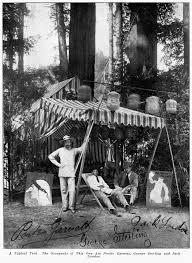
At the Dirtlease corporate retreat, Legal, Economics and the Founder wandered away from the group looking for a place to piss.
‘Dude’, the Founder told Legal. ‘Do not hook up with HR.’
Economics bent a sapling branch and snapped it back at Legal.
‘Ow.’
‘It would be wrong on so many levels.’
‘You take care of your you-know-what. I’ll take care of mine.’
The group approached a large pine tree and reproduced the album cover of Who’s Next. When they were finished, they turned back to the clearing where they had left the rest of the group. Legal followed the Founder. Economics took up the rear. The moon was gibbous.
‘How did you manage to get us into this place’, Legal asked. ‘I mean, it’s Bohemian Grove.’
‘I dunno’, the Founder said. ‘You polish a few apples, kiss a few asses. Things fall into place.’
‘False modesty does not become you’, Economics said.
‘I have plenty to be genuinely modest about’, the Founder said.
‘Where have you been’, Legal asked. ‘I mean, I haven’t seen you for weeks.’
‘I have been worrying about the law of excluded middle.’
Economics planted his face in his hands.
‘Oh, for fuck’s sake.’
When they reached the clearing where they had left the rest of the group, they found it empty. A Coleman stove with a tea kettle on it sat inside a ring of small stones. Economics struck a match and fired it up.
‘I was a French major’, Legal said. ‘What is the law of excluded middle?’
‘It is a fundamental principle of classical logic’, Economics said. ‘It is the idea that, for any proposition, either it is true or its negation is true. You write it, (P v -P)
‘I thought you flunked symbolic logic’, Legal said to the Founder.
‘Almost.’
The kettle began to boil. Economics poured the brew out into three tin cups, two of which he handed to Legal and the Founder. When he drank, Legal made a face.
‘This stuff really does taste like mushrooms.’
‘Well, duh.’
The three put their feet together and lay down on their backs, arranging themselves like a watch with three hands.
‘How many degrees separate us’, Legal asked Economics
Economics handed Legal a calculator. ‘Figure it out’, he said.
‘Why are you worried about the law of excluded middle?’
The Founder noticed that the contrast in light between the branches of the trees in the canopy overhead and the sky was quite sharp, even though it was night. There appeared to be more stars than he remembered.
‘In Yee v. Escondido, 503U.S. 519 (1992)’, the Founder said, ‘the Supreme Court examined the constitutionality of rent control statutes. It held that rent control without a decontrol provision was not a physical taking. It reserved on the issue of whether there was a regulatory taking.’
‘By reserved, you mean punted, right?’
‘Correct.’
Legal noticed that he had to piss again. Economics pinched his nose to capture a gnat.
‘In Yee, the petitioners were owners of a mobile home park in Escondido. California had passed a state-wide law that limited park owners’ ability to evict tenants to nonpayment of rent and change in use. The state law also authorized municipalities to pass rent control laws. Escondido passed a rent control law.’
‘Wait’, Legal said. He paused, as if he had seen a ghost.
‘What?’
‘Park owners couldn’t evict people for noncompliance, like trash, pitbulls, cooking meth, or clogging the septics with baby wipes?’
‘The decision does not mention that. Can I continue?’
‘Please.’
‘The rent control law in Yee did not have a decontrol provision. In other words, when a tenant sold a home to a new resident, the purchaser of the home succeeded to the seller’s below-market lot rent. Lot rents stayed the same until Judgment Day.’
‘What did they charge?’
‘The decision doesn’t state a dollar amount.’
‘They couldn’t raise lot rents at all?
‘As of the effective date of the act, lot rents were rolled back to 1986 levels. Any increase had to be approved by the city council. In determining whether to allow an increase, the city council was required to consider, inter alia, (i) changes in the CPI, (ii) lot rents at comparable parks, (iii) the length of time since the last increase, (iv) the cost of capex, (v) changes in property tax rates, utility charges and other operating costs, (vi) increased costs of maintenance and repair, and (vii) the amount and quality of services provided to the applicable tenant.’
‘You mean’, Legal asked, ‘park owners had to get approval for each increase in lot rent from the city council, and to do that, they had to produce evidence and plead their case as if they were applying for a variance from the zoning board?’
‘Correct.’
Legal burst into tears. Then, he wiped his eyes with the back of his hand and said, ‘Sorry.’
‘The Yees claimed that the combination of restrictions on evictions and rent control constituted a physical taking’, Economics continued. ‘They said that the laws had the effect of depriving them of all use and occupancy of their real property and granting the tenants of homes in the park, as well as those tenants’ successors in interest, the right to physically occupy their property permanently. Effectively, the limitation on holdover evictions, coupled with the lack of decontrol, forced them to lease their property to other people at below-market rates in perpetuity. That, they said, was as much a taking as running a bulldozer through the property.’
.
‘My wife had cancer last year’, Legal said.
‘I am so sorry.’
‘She’s OK now, though.’
‘What happened?’
‘By the time it was diagnosed, they told us she had two months to live. We moved her to hospice.’
‘Oh, my God.’
‘I spent most of my time with her, but I had to go home sometimes, too. One morning, when I showed up, I barely recognized her. She weighed sixty pounds, she was covered with sores and she walked like she was a hundred years old. She tells me, ‘Myron. Have sex with me.’’
‘Excuse me?’
‘She didn’t say, ‘Have sex’. She used the f word.’
The Founder noticed an uneasiness in his gut that permeated the grove. He contemplated asking Legal to shut the fuck up. Instead, he said, ‘Nu?’
‘So, I got in bed with her and we did it. Far from me to deny a dying woman.’
‘You mean, you had the sex?’
‘Correct. We had the sex.’
‘And?’
‘And the next day, she looked better! She was sitting up, she had her appetite back, and there was some color in her cheeks. So, she tells me, ‘Myron. Have sex with me.’’
‘Did she use the f word again?’
‘Oh, yeah. So, I climb into bed, and we do bunga-bunga. But we don’t just have sex. We have mind-blowing, write-it-in-the-sky-for-everyone-to-read sex. We did Utphallaka, Parshva Samputa, Piditaka, Shulachitaka, Padmansa, Indranika and Yab-Yum. I mean, we always had fun in the sack, but this time, I think I achieved Maithuna. Eventually, a nurse banged on the door and asked us to knock it off. Other residents wanted to rest.’
‘How do you say ‘reverse cowgirl’ in Sanskrit?’
‘I think it is Virsha.’
‘Continue’
‘So, I came back the next day, she was all better. I mean, cured. It’s as if it never happened.’
Legal put his face in his hands and sobbed. Then, he balled his hands into fists and beat his head against the ground. The Founder put his hand on his back and patted it. He thought about how he could keep Legal from harming himself.
‘Dude. It’s OK. Your wife is alive. We’re here with you.’
Legal batted the Founder’s hand away.
‘You don’t understand’, he said. ‘I could have saved my mother!’
.
‘Did the Court hold that the California state and municipal laws constituted a physical taking’, the Founder asked.
‘No’, Economics said. ‘O’Connor said that there was no physical taking because the Yees voluntarily rented their lots to their residents. Because of that, there was no physical invasion. And the Yees could, the Court said, get rid of the residents. Under California law, park owners could evict tenants if they converted a park to a different use. For example, if the Yees wanted to tear down the park and build an apartment complex, or sell the land to Home Depot, they could require tenants to leave.’
Legal tore his shirt and beat his breast.
‘That’s bullshit’, he wailed. ‘That makes no sense at all!’
‘Tell us how’, Economics said.
Legal sat up straight, wiped his eyes and fought to regain his composure. ‘There are two problems with O’Connor’s argument’, he said. ‘The first is that the Yees rented the lots in their park before the effective date of the law. When they entered into their contractual relationships with their residents, they had no idea that the law was going into effect. To say that a poker player voluntarily enters a game when he does not know that the deck is stacked is just not true.’
‘A strong argument’, Economics said.
‘I also think that the argument that the Yees did not lose the right to exclude because they could evict residents if they changed the use of the property is cutting the baloney very thin’, Legal said. ‘Sure, they could kick everyone out if they decided to redevelop the park as a shopping mall or a laser tag arena, but that kind of conversion is expensive, burdensome and time-consuming. Mom-and-pop owners like the Yees can’t do that.’
The Founder closed his eyes and visualized McMurtry songs. Song for a Deckhand’s Daughter was soft and billowy until the end, when it firmed up. Chocktaw Bingo was spiky.
‘Did the Court mention unintended consequences of the rent control statute’, he asked.
‘They discussed them’, Economics said, ‘but they did not affect the decision.’
‘What did the Court say?’
‘O’Connor discussed the way a rent control statute without a decontrol provision redistributes economic burdens between existing residents, new residents and park owners. On the effective date of the rule, the benefit of the right to below-market lot rent is bestowed on park residents. Because this is a zero-sum world, this shifts an equal and opposite burden on park owners.’
‘So, you mean that park owners are dragooned into performing a public service, even though they are private actors?’
‘Yes.’
‘That is unjust.’
‘Suck it up.’
In Canola Fields, McMurtry’s narrator asked his past lover to take a death grip on some part of him.
‘The unintended consequence happens when the resident sells her home’, Economics continued. ‘Remember, most park residents own their structure and rent the land that it sits on. Their home is an asset that they can buy, sell, devise or hypothecate.’
‘That allows people who can’t afford stick-built houses to build wealth by buying a home.’
‘In a free market.’
‘Elaborate.’
‘After the effective date of the rent control statute’, Economics continued, ‘When a resident in the Yees’ park decided to sell, they would be selling not just a home, but a home that comes with the right to pay below-market lot rents. That right would be baked into the price of the home. Assuming rational counterparties, the price of the home would be increased by the present value of the difference between the cost of paying market lot rent and the cost of paying below-market lot rent.’
‘So the person who bought the home from the first resident would not benefit from the rent control statute, because the buyer would pay an inflated price for the home.’
‘That’s right.’
‘The value of below-market lot rents would be offset by the increased price that they would have to pay to buy the home.’
‘Correct.’
‘The only effect of the statute is to provide a windfall for residents in place on the effective date.’
‘Uh-huh.’
‘And to screw park owners.’
‘Yup.’
‘I gotta hurl.’
Legal stood up and left the clearing. After he vomited, he coughed and snuffled a bit. Then, he re-joined his friends.
‘What happens if there is a decontrol provision’, Legal asked.
‘That’s what we have in New York’, Economics said. ‘Lot rents are decontrolled between residents. When a new resident buys a home, lot rent for that home can increase in excess of the three-to-six percent cap.’
‘Does that cause confusion with residents’, Legal asked.’
‘All the time’, the Founder said. ‘When a resident sells her home, the buyer might ask the seller what lot rent is. The seller will say, ‘I pay $465 a month’. That statement is true, but not relevant to the buyer. Lot rents must, and will, go up to market between buyers.’
‘What is market for a lot rent?’
‘About $600 in our markets. Lot rent should be half what a two-bedroom apartment goes for. Apartments by our parks rent for over $1,200.’
‘What do you do when new residents whinge about their lot rent?’
‘I remind them that, with apartment rent what it is, they are getting a bargain. I also encourage them to write their state senator and assemblyperson, to urge them to repeal the rent control law that went into effect in 2019. A bump in rent upon decontrol is an unintended consequence of any rent control law. The way to get rid of an unintended consequence is to get rid of the cause.’
Legal looked pensive, and then teared up. ‘Do you think’, he said, ‘that the New York State law as written has an effect on the value of manufactured homes in parks, the way the California law that the Supreme Court discussed in Yee had?’
‘Similar but opposite’, Economics said. ‘Rent control statutes with decontrol provisions ensure that lot rents will jump between residents. I mean, we need to fill potholes and replace Orangeburg pipe. Operating costs go up. We need to increase revenue. We can’t do that by increasing existing residents’ lot rents beyond the cap. That means that, between residents, lot rents will increase significantly. Because of that, when a buyer purchases a home in a New York park, they will purchase a home that is connected to an obligation to pay higher lot rents. Assuming rational counterparties, that will depress the price of the home.’
‘But-‘, Legal said,
‘Yes?’
‘Isn’t a park resident’s home the biggest asset they own?’
‘It is.’
‘And aren’t these people poor? I mean, that’s why they live in manufactured housing?’
‘They are.’
‘So, the effect of the law, which is intended to help poor people, is to screw poor people?’
‘Yup.’
‘And, as we discussed in the context of Yee, rent control laws without decontrol provisions have the same effect, i.e. that they screw poor people?’
‘That’s right.’
‘And what were you saying about the law of excluded middle?’
Legal wiped his face with the back of his hand and looked at the Founder with puppy-dog eyes.
‘It is the rule that every proposition either is or is not true.’
‘So, a rent control statute either includes a decontrol provision, or it does not?’
‘Right.’
‘And poor people get screwed either way?’
‘Uh-huh.’
Legal burst into tears and began to daven. ‘The humanity’, he said. ‘O, the humanity.’
.
‘What did the Court say on the regulatory taking issue’, the Founder asked.
‘A lot of nothing’, Economics said. ‘O’Connor spent quite a bit of ink describing how, although the issue of a regulatory taking was litigated at the state court level, it was not properly included in the petition to the Supreme Court. Court rules prevented the consideration of issues not raised in the petition except in extraordinary circumstances. She acknowledged that courts like narrow holdings because holdings that are not made can’t be overturned or criticized. It is a shame that the court punted on the issue, because the regulatory taking claim seems to be more robust than the physical taking claim.’
‘What is a regulatory taking?’
‘It is when a government regulation restricts property usage so severely that it effectively deprives the owner of economic value.’
‘That is exactly what rent control laws do!’
‘Yes, it is.’
Legal lay next to the two other men, sobbing quietly. The Founder put in his ear buds and turned on spotify. He saw Pinocchio in Vegas, cleaning everyone else at the poker table out good. He took a sleeping mask out of his backpack. Then, he hesitated and took the earbuds out.
‘Hey’, he said to Economics.
‘What?’
‘You don’t seem affected by the mushrooms. Why is that?’
‘Oi.’
‘Elaborate.’
‘Psychedelics are like a power tool. You can do a lot of good with them, and also a lot of harm. When they are used well, they can be a catalyst. They won’t get you to enlightenment, but they can give you the means to do the work to approach enlightenment.’
‘So?’
‘So, they don’t affect me. I’m already there.’