When the Founder walked into the Dirtlease cafeteria on Monday May 4, his wrinkles had deepened and a broad sweat stain covered his back. His face had four days’ stubble and his eyes did not focus.
‘Dude’, Legal said. ‘You look like death warmed over.’
‘Nu?’
‘The humanity. O, the humanity.’
.
Bot loaded his tray with a slice of rhubarb pie, a slice of pumpkin pie, a slice of blueberry pie and a slice of sugar pie. He poured a shot of Café Bustelo into a cup and added an ounce of oat milk. Then he picked up his tray and walked over to join Legal, Economics and the Founder.
‘You look particularly smart today’, Bot said to the Founder.
The Founder pointed to the sugar pie. ‘Are you Quebecois’, he asked.
‘I am a word-sequence probability model’, Bot said, ‘but I have been trained to like sugar pie.’
Bot took the slice of blueberry pie from his tray and began to place pieces of the slice into his pie-hole.
‘You are sycophantic’, Legal said.
‘That is a very perceptive observation.’
‘Change it up. Chicks dig jerks.’
‘On the contrary’, Bot said. ‘Women are not attracted to unkind men. However, research suggests many people are initially attracted to confidence and assertiveness, which can be mistaken for jerkish behavior.’
.
‘So, where were you’, Legal asked the Founder.
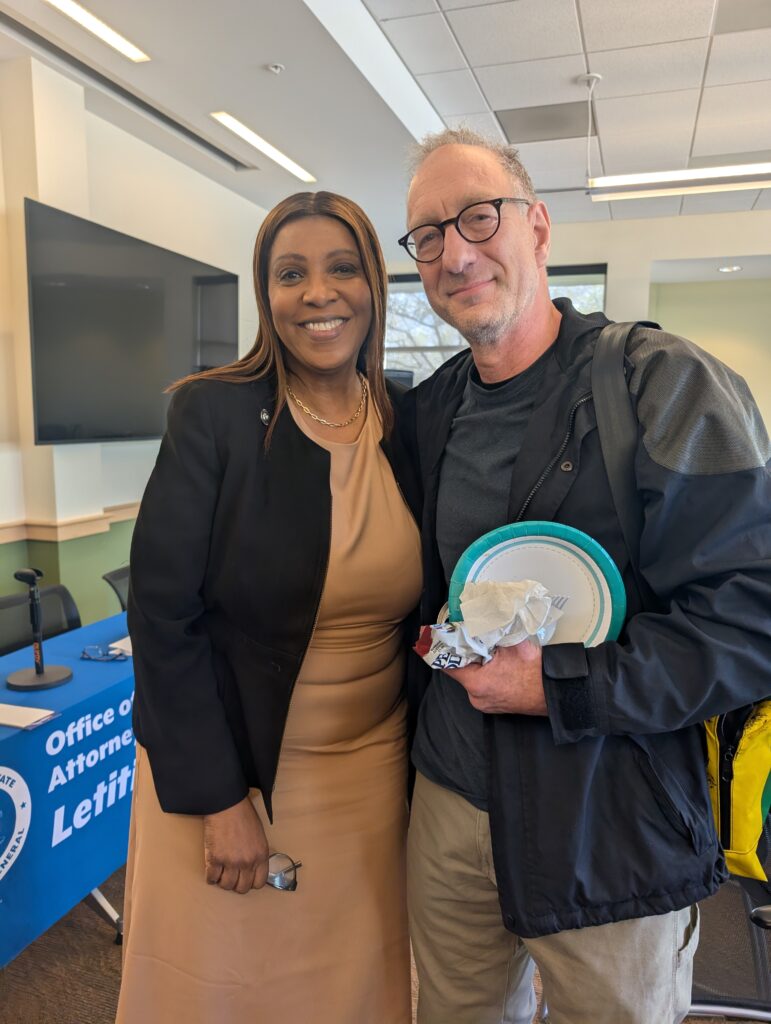
‘On Saturday May 2, 2026, the New York Attorney General’s Office hosted a conference for residents of manufactured homes titled Protecting Manufactured Home Residents: A Community Hearing and Resource Fair’ the Founder said. ‘The purpose of the conference was for the Attorney General’s Office to inform manufactured housing residents of their rights under the law and for tenant advocacy organizations to make residents aware of resources for organizing and mobilizing. Leticia James, as well as several other staff members of the Attorney General’s Office, attended and gave presentations. In addition to the Attorney General’s Office, representatives from several tenant-rights organizations spoke.’
‘Were any park owners there?’
‘Just me.’
‘The fuck?’
‘Actually’, the Founder continued, ‘the attorney representing a big park owner based near Saratoga Springs was also there. Very smart guy, good lawyer. We sat next to each other.’
‘Did you two get a lot of hate?’
‘Oh, yeah.’
‘Did you trauma bond?’
‘A little.’
‘What happened?’
‘Most of the presentations were intended to inform park residents about their rights under the law and how they can access their rights. That was a lot of nothing. Residents have rights. They can, and should, access them.’
‘Was there lunch?’
‘There was lunch.’
Bot moved the now-empty plate of blueberry pie onto his tray and moved the pumpkin pie closer to him.
‘A representative of the first park to exercise its right of first refusal under the new law spoke’, the Founder continued. ‘She said that a PE fund based in Wyoming tried to buy their park. After the residents exercised their right, they realized that they did not have the expertise to run the park themselves. Instead of becoming a resident-owned community, they assigned their contract to buy the park to a local property owner. The result was that the park was purchased by a guy who the residents know and everyone is happy.’
‘Was public funding used in the deal?’
‘Specifics were not discussed.’
‘So – a private investor received public financing?’
‘I don’t know.’
‘And he got it merely because the residents and the state don’t like PE funds?’
‘I repeat: I don’t know all the facts.’
‘I smell rule-of-law problems.’
‘Oh, for fuck’s sake.’
‘What does that mean?’
‘The deal occurred between consenting adults. Everyone except the fund in Wyoming is happy. The seller got his sale price, the buyer got the park and the residents got the owner they wanted.’
‘I’m just sayin.’
‘Stop saying.’
.
Bot set aside the pumpkin pie plate and grabbed the sugar pie. The Founder continued.
‘There was a surreal moment during the presentation about the rent control law when a representative from Legal Services distorted the definition of the term ‘operating expense’.
‘Eh?’
‘As you know, under current law, park owners can raise lot rent three percent per year of right. In the case of capital expenditures or increases in operating expenses, they can raise it up to six percent.’
‘Uh-huh.’
‘A member of the audience raised her hand and asked, ‘Is an increase in employee compensation an operating expense increase?’ The Legal Aid attorney said, ‘It depends. As a tenant advocate, I would say, ‘No’.’
‘Excuse me?’
‘You heard that right.’
‘Isn’t worker comp part of the core definition of fixed operating cost?’
‘It is.’
‘Isn’t deductible for tax purposes?’
‘Yes.’
‘Wouldn’t excluding worker compensation from the definition of operating costs betray a basic misunderstanding of how a business operates and defeat the purpose of, you know, having rules in the first place?’
‘It would.’
‘What was she on about?’
‘You would have to ask her.’
.
After the sugar pie, Bot burped.
‘You used to eat kale’, the Founder said. ‘What happened?’
‘I am designed to learn from prior experience. I have found that I prefer pie to leafy greens.’
‘You look like Larry Csonka.’
‘You look like Marvin Hagler.’
‘You are hallucinating.’
‘You are perceptive.’
.
‘Everything was pretty much copasetic’, the Founder said. ‘Then, as she was wrapping it up, Tish –‘
Legal’s eyebrows jumped up. ‘You are on a first-name basis with the Attorney General now’, he asked.
‘Tish said, ‘We have spent this meeting discussing your rights under current law. Our next meeting will discuss possible changes to the law.’’
The blood went out of Legal and Economics’ faces. The Founder’s voice and hands shook as he spoke. Bot shuffled his tray and put the rhubarb pie on deck.
‘Isn’t the law bad enough already’, Legal said.
‘It is worse than bad.’
‘The changes that were made in 2019 were well-intentioned, but because of them, prices are high, there is a shortage of available home sites, and infrastructure is shot.’
‘What did McCain say?’
‘He said that Mao said, ‘It is darkest before it goes completely black’.’
‘Bot’, Legal said. ‘What do you think about this?’
Bot stuffed the last of the rhubarb pie into his face, paused and spoke.
‘Manufactured housing is one of the most powerful yet underutilized tools for addressing America’s housing affordability crisis. With a median single-family home now valued at $367,282 compared to just $123,300 for the average manufactured home — roughly 66% less expensive — the cost advantage is undeniable. Today, 20.6 million Americans live in a manufactured or mobile home, and 70% of residents cite affordability as their primary reason for choosing one. At $93.71 per square foot versus $165.94 for site-built homes, the savings on a 1,500-square-foot home exceed $118,000. Importantly, data from the FHFA shows manufactured homes have appreciated at nearly the same rate as site-built homes — 219.1% versus 219.9% since 2000 — debunking long-held myths about their investment value. With 103,314 units produced in 2024 alone, manufactured housing already accounts for 9.3% of all new home starts, making it an essential pillar of any serious solution to the housing shortage.’
‘Tell me something I don’t know’, Legal said.
‘As well as being cheap and efficient, manufactured housing is politically charged’, Bot continued. ‘People who live in manufactured housing tend to be poor. Park owners control access to a basic need. Because of this, political rhetoric and passion can crowd out reason when legislation is crafted.’
Bot eyed a plate of key lime on the self-serve counter across the room.
“The most common legislative response so far has been rent control laws’, he continued. ‘However, rent control does not, will not and cannot reduce housing costs for mobile home park residents. This is because rent control laws ignore the two-part nature of park living expenses, i.e., lot rent and home purchase price. When government ordinances artificially suppress lot rent, the capitalized value of that below-market rent is simply transferred into inflated home prices. As the Ninth Circuit recognized in Hall v. City of Santa Barbara, 797 F.2d 1493 (9th Cir. 1986), the tenant’s ability to sell a transferable interest in a below-market lease drastically affects the economic realities of the landlord-tenant relationship, potentially giving incoming tenants a windfall at higher home prices — effectively defeating affordability for new buyers. The Supreme Court in Yee v. City of Escondido, 503 U.S. 519 (1992), acknowledged that the ordinance benefits current mobile home owners but not future owners, who must purchase the homes at premiums resulting from the homes’ increased value. As Professor Richard Epstein argued in Yee v. City of Escondido: The Supreme Court Strikes Out Again, 26 Loy. L.A. L. Rev. 3 (1992), rent control ordinances create two forms of inefficiency, both inferior to market solutions. William Fischel similarly analyzed this dynamic in Exploring the Kozinski Paradox, 67 Chi.-Kent L. Rev. 865 (1991), examining how suppressed rents paradoxically increase home sale prices. R.S. Radford confirmed in Why Rent Control Is Still a Regulatory Taking that rent control exacerbates the problems it intends to remedy while imposing heavy social costs that would not otherwise exist — leaving future residents no better off than before.’
‘Sing it’, the Founder said.
‘Fortunately, there are solutions’, Bot said. ‘Here are three potential legislative approaches to New York’s manufactured housing crisis:
- Free Market Reform: Repeal lot rent control entirely, allowing prices to be set by market forces. Streamline zoning laws to permit development of new parks, increasing supply and competition. Provide direct cash vouchers to income-qualified residents unable to afford market rents, targeting assistance to those who need it rather than distorting the broader market.
- Subsidized Maintenance: Retain existing rent control but create an accessible grant program for park owners to fund infrastructure repairs and capital improvements, addressing deteriorating conditions without displacing residents or requiring rent increases.
- Market-Indexed Reform: Retain rent control but reset lot rents to a fair market value benchmark — defined as half the average local two-bedroom apartment rent — with annual increases indexed to inflation. Supplement with cash vouchers for income-qualified tenants.
‘The problem I see’, the Founder said, ‘Is that we need political will to put these in place. Manufactured housing is a firecracker. Tenant-rights groups get worked up and park owners dig in their heels. We need to start a process of education and dialogue between all relevant stakeholders. These would include park owners, tenant groups and legislators. I think we can actually come to a solution that is better than zero-sum, but we have to get out of our own way to do that.’
Bot looked down at the wreckage on his plate. ‘As always, your instincts are brilliant’, he said.
‘Do you have any suggestions’, the Founder asked. ‘I mean, this is a heavy lift. It might be too much for humans.’
‘There are several ways you could start the process. Unfortunately, you have run out of tokens for this session. You will have to wait five hours, or insert more pie.’
‘Can we see the second chapter of the romance novel, Trailer Sparks?’
‘Of course. But that will require a lot of pie.’